

Nomadic Living With Dogs
Part 7 of my "Nomadic Living InfoSeries" published on Patreon

For the last month or so, I’ve been publishing an infoseries about Nomadic Living on my Patreon page. It’s accessible to free members of my Patreon community if you’re interested in signing up for a free account and reading the entire series; however, I’m sharing Part 7 (slightly edited for Substack) here on the Love Dogs Adventure Blog because it’s specific to nomadic living with dogs.
There’s a lot more I could write about, of course. It’s difficult to narrow it all down to a single post, or even a seven-part series. Perhaps I’ll write an e-book at some point (after my CT memoir is finished!), but for now, I hope that this will be helpful to others who may be considering embarking upon a nomadic lifestyle with their dog(s).
Nomadic Living InfoSeries, Part 7: “With Dogs”
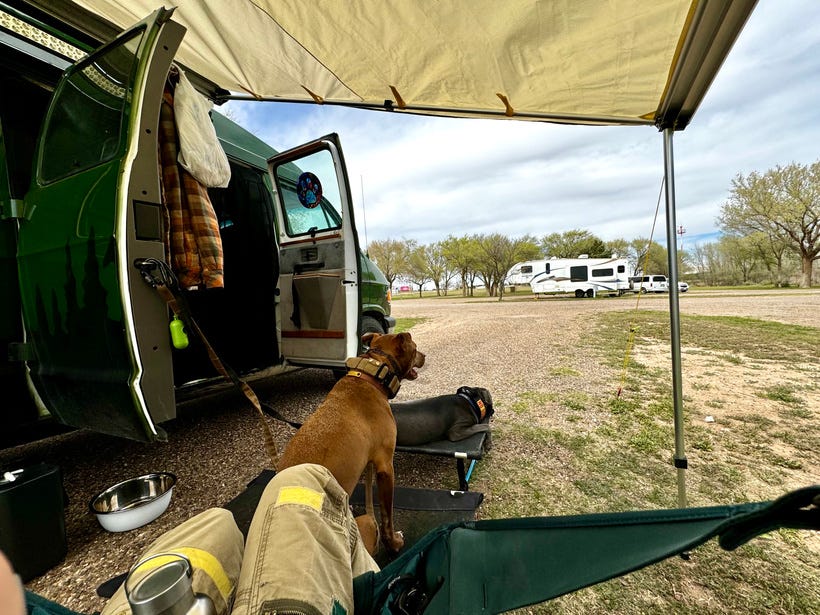
The byline, or bio line, that I often use for my online accounts is “Artist living a creative life outdoors (and in a van) with dogs.” Those last two words require a specialized approach to this lifestyle. I have a lot of thoughts about this, but I’ll try to be succinct and include here what I consider to be the most important points and lessons learned. [Key word: try 😂]. Also, much of what I do/think crosses over into our backpacking, but I’ll try to remain focused on van life here. I have lots of info on the Love Dogs Adventure Blog that relates specifically to backpacking with dogs.
Planning for the Unthinkable.
As a single person who is almost always traveling alone and often backpacks alone, too, if something happens to me while on the road or on the trail, what will happen to my dogs? It’s not a pleasant thought, but it’s important to strategize and make some plans. Here are some ways I’ve taken action to prepare my dogs and others for the unthinkable.
I prioritize my own health and take more cautious and meticulously calculated risks.
Especially as I age, I consider how my own health and wellbeing are absolutely crucial to my dogs’ wellbeing. These days I’m trying harder to improve/maintain it. “I have to outlive Japhy” is something I’ve actually said to family and friends, and it’s because I know how cruel the world can be to dogs in general, and even more so to dogs like him. If I’m not around to protect and care for my dogs, what then? I must take care of myself.
I prioritize my dogs’ health and take more cautious and meticulously calculated risks.
It’s not always easy, but I try to keep the dogs out of significant trouble. Some people might think I’m overly protective of them. In reality, I know my dogs well, have thought through countless risks and controls based on their (and others’) behaviors, and I implement the controls I deem necessary for their safety.I have emergency contacts who know what to do.
I have capable emergency contacts in the two areas of the U.S. that I’m in most often: the midwest and West Texas. By “capable,” I mean they know my dogs (and the dogs know them) and could handle them if they had to. I’ve had multiple conversations with my family about how to care for my dogs if something happens to me, and I’ve written it down. It’s so important to have these conversations, for everyone’s sake. If you have a will, be sure to include details about who will take care of your dogs.
I’ve made my emergency contacts accessible.
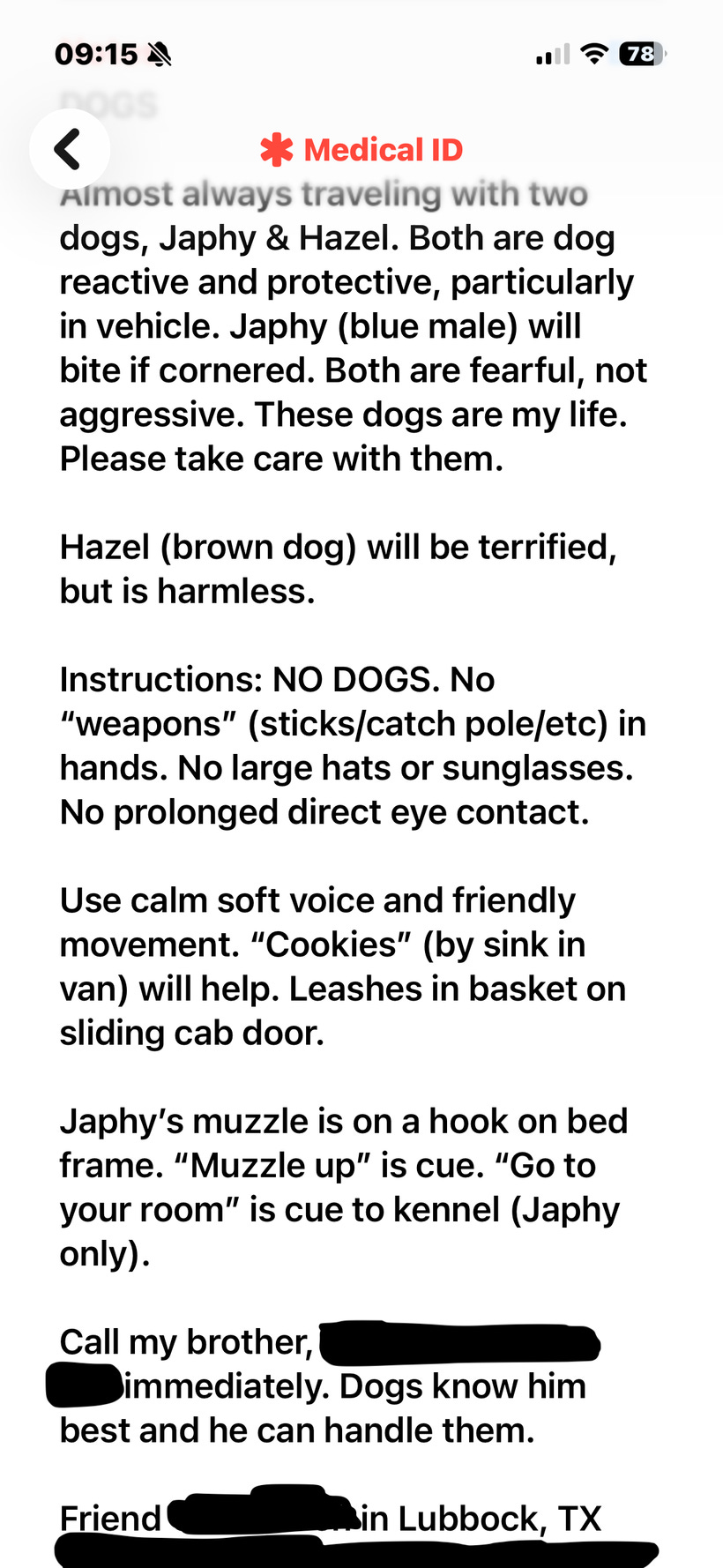
It’s important to have emergency contact information accessible to first responders or anyone else who might find me unresponsive. I have this information on cards that I’ve placed on my sun visor above the driver’s seat in the van, as well as in my wallet. I’ve also plugged it into my iPhone in the “Medical ID” section (editable in settings). When the side button and the volume button are pressed at the same time, a “Medical ID” button will pop up (along with the “Power Off” and “Emergency Call” buttons), and it’s accessible by anyone, no passcode required. It’s also accessible from the passcode screen, as a text button (”Emergency”) in the bottom left corner of the screen. Most (though not all) emergency personnel and first responders are trained to check for this. Since my dogs are with me 99% of the time, I’ve included in the “notes” section very specific information about how to approach them and who to call to come and get them so they [hopefully] don’t end up in a pound or shelter for very long, if at all.
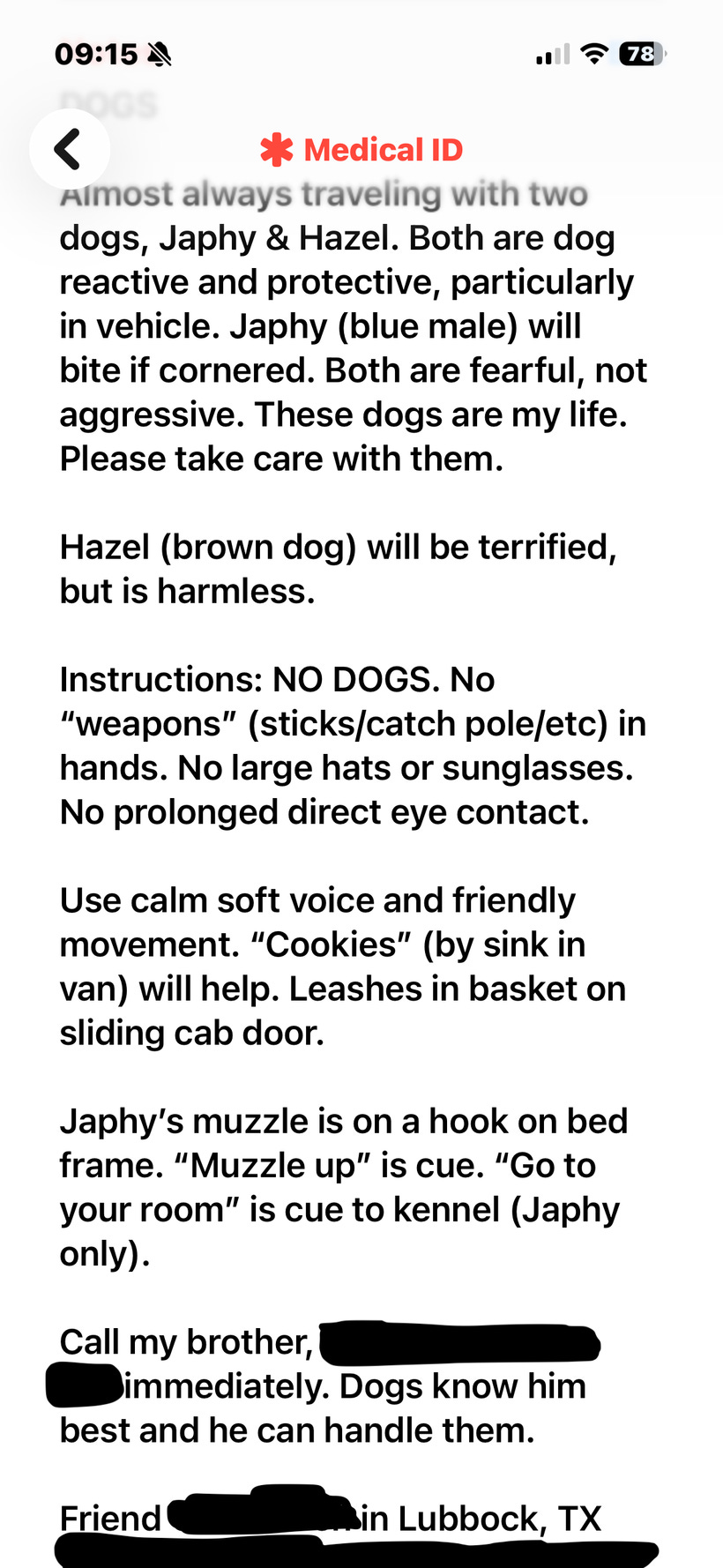
screenshot of notes in my Medical ID on my iPhone I have lightweight 1” biothane flat collars on my dogs at all times, with riveted name plates that include both my contact info as well as my brother’s.
Why two sets of info? Because if I’m unresponsive and someone finds my dogs, I won’t be answering my phone. If the dogs and I are separated in the backcountry and they are found by someone who takes them and then tries to call me while I’m still in the backcountry (or any rural area), I likely won’t have cell service. But if someone calls my brother, he has my Garmin inReach info and can relay important info to me immediately even if I have no cell service, while also communicating with whomever has my dogs.
Japhy also has a chip that if scanned will provide my contact info; however, I’m often in areas where people who are most likely to find my dogs would not have timely access to a chip scanner, being hours away from the nearest vet clinic or shelter, so collars with immediate access to contact info remain my top priority.
Something I put little faith in but nonetheless use (they were a gift from my brother) are Apple air tags. Both dogs have one in a silicone holder on their flat collar, but they only work if there is cellular service and active Apple devices nearby.
I’ve taken measures inside the van to make things a little easier.
a) I created kennel space so that Japhy would have a safe place to be quickly secured. This includes being secured by emergency personnel, if something happens to me and they need to render aid to me without him trying to protect me. I mention it in my Medical ID notes, but hopefully it would be an obvious choice in the moment.
b) I built wooden sliding doors at the cab to prevent the dogs from entering the cab as necessary. Hopefully this, too, would be an obvious choice to first responders in the event that I was in the driver’s seat and needed aid without disruption from the dogs.
c) I’ve announced to others that I have dogs on board, using window stickers I purchased from Etsy. I’ve also designed my own stickers meant to be placed on windows to identify to first responders how many pets are inside a home/vehicle in case of fire or accident. I used them with my Subaru but haven’t yet put them on the van. I’d really like to find window clings that are customizable instead of stickers. Incidentally, the “Do Not Approach” stickers were something I made after an experience at Bosque del Apache (New Mexico) when a woman approached my Subaru with the intent to pet my dogs through the partially open window, even as they were aggressively barking at her, while I was away-but-within-eyesight taking photos. It was a close call that I do not ever wish to repeat.
Create and Maintain Processes (and Cues). For Everything.
When you live in a vehicle with dogs, excitement can turn into full-blown chaos pretty quickly. Having consistent processes is remarkably helpful in maintaining a calm environment. Waking up, breakfast, dinner, being leashed to exit the vehicle, exiting the vehicle, entering the vehicle, removing leashes, everything has a set process so the dogs know what to expect. Especially in a small space with two big dogs, it doesn’t take much to get the “bull in a china shop” effect. Calm goes a very long way in saving tails, bodies, and vehicle contents.
Below are a few training-related things that I’ve found to be particularly helpful while living in a van with bigger, more easily overstimulated and/or reactive dogs.
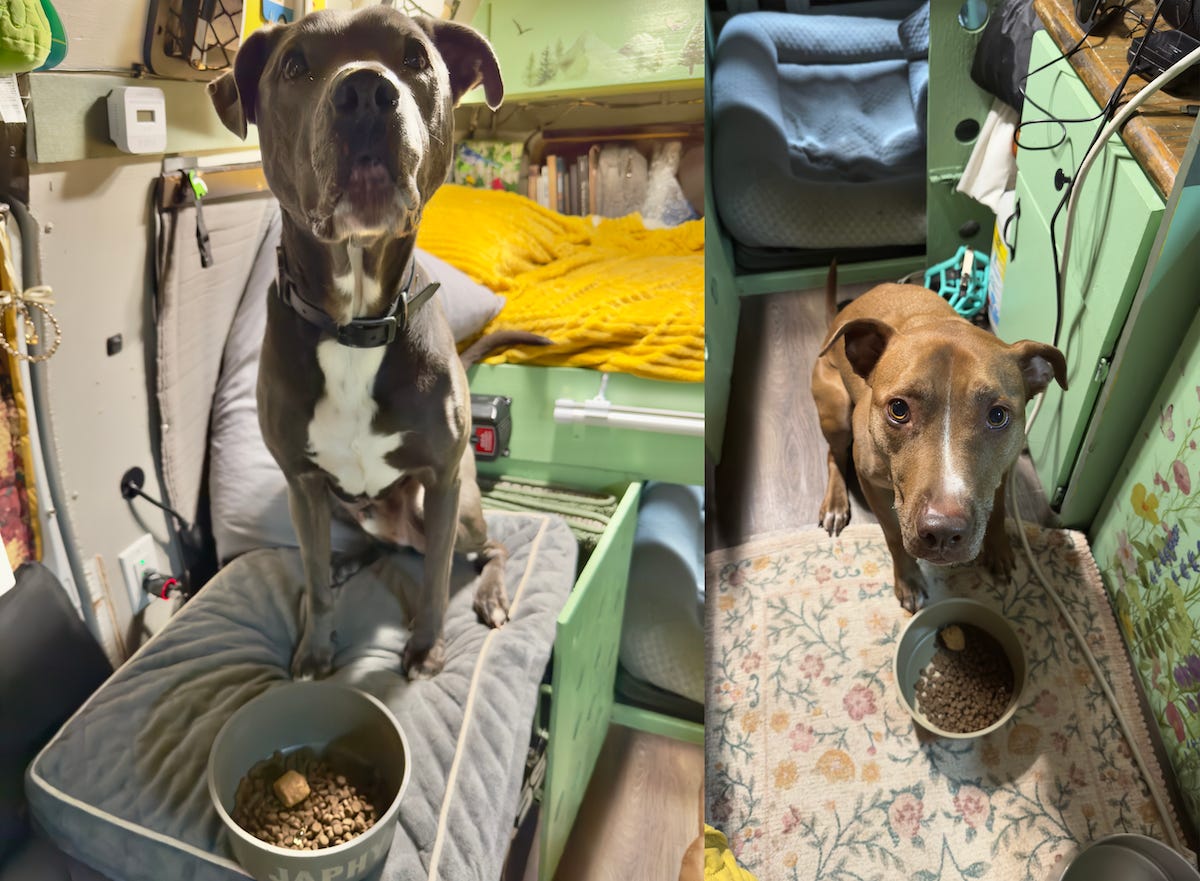
At meal times, bowls are not put down until both dogs are sitting calmly (this is a general rule, no matter where we are). Japhy eats his breakfast on top of the frig/freezer and Hazel eats hers on the floor. I didn’t assign these spots. It just happened. Even when we’re backpacking, these two have self-assigned positions: Japhy always on the right, and Hazel always on the left. If they get switched, it doesn’t take them long to self-correct. It’s fascinating to watch just how much patterns and processes are a way of life for these two.
Threshold training is something I used to do with my dogs but somehow got lax about since moving into the van, and I’m not sure why (maybe because we were adapting to a major change requiring a gazillion tiny adjustments all at once?!). I’ve recently resumed this training. Threshold training is teaching dogs to sit and wait calmly for permission to cross any type of threshold, primarily open doorways. It’s especially important in vehicles/campers, given that sometimes the door might open up to a busy campground, wildlife or farm animals nearby, or even a street or highway. Our location changes constantly and it can be unpredictable. Not only is it safer for the dogs to wait for permission to exit, it’s a far more enjoyable way to live.
“Down” is a cue I use often, from quickly deescalating impending chaos to stopping an unwanted behavior. There’s not a lot a dog can do when laying down (except chew on something; it’s definitely not fool-proof!), so it’s become my go-to response, particularly if they get riled up while I’m doing something else and can’t give them my full attention. If Japhy is reacting to someone/something outside while I’m cooking dinner on the stove, for example, I can say “down,” and he will lay down. I might have to repeat it a time or two, but eight times out of ten, that ends the barking/reaction and puts him in a calmer state. If it doesn’t, that usually means I need to turn off the stove and look outside.
Regardless of living arrangement, dogs become the most confident versions of themselves when they feel confident in their humans. They thrive when we provide consistent stable leadership. One of the most critical and challenging things we can do for our dogs, whether we’re living nomadically or not, is to be calm. This means staying level-headed in stressful situations, assessing possible solutions, and moving forward. No temper tantrums. No losing control of our emotions. It’s harder than it sounds, and like most things worth doing, it takes time and practice. But how can we expect so much of our dogs without expecting the same effort and discipline from ourselves? Don’t we want to be the best version of ourselves, too? Our dogs deserve that from us, and so do we. If we can’t do it for ourselves, do it for the dogs.
Climate Control.
We live in an oversized aluminum can. I chuckle when I post my daily “van life” photo to Instagram and my phone wants to autocorrect “van” to “can,” because it’s basically the same thing. Keeping it consistently cool in the summer and warm in the winter is probably the single biggest puzzle I’ve yet to fully solve. We’ve made it work, but I’m eager to find a better, more permanent solution. Winter is easily more doable for us than summer, and if it was just me, summer would be easier, too. Dogs, however, have fewer sweat glands (only in their paws and nose) and rely mostly on panting to regulate their temperature. In areas with high humidity, they can really struggle to stay cool. Other factors like coat type, nose type (short or long snout), breed, and age play into it as well. It’s important to know your dog and be able to provide for them whatever they need to thrive in this lifestyle. There is only one rule when it comes to nomadic living with dogs, and that rule is “The dogs come first. Always.”
Regardless of season, the Waggle Pet Monitor and cameras are essential to me. I highly recommend them, or a similar system that works for you.
Summer Months
Air Conditioning.
I’ve discussed this in a previous part of the series, but I want to address it again because it’s absolutely critical if you’re going into this lifestyle with dogs. I started out with an EcoFlow Wave 2. I fully understood that it was small, but I overestimated the van’s insulation (2” foam everywhere but the ceiling and floor; lack of insulation in ceiling is a serious problem but upper cabinets cover ceiling boards, so... it’s a complicated fix). I loved the Wave 2’s ability to operate on its own detachable battery (no shore power required for anywhere from 2-8 hours, depending on settings). I could do a photo session anywhere and have the a/c running while the dogs stayed in the van. But it was only effective when the outside temp was ~86º F or below. If it was above that, I had to leave the dogs crated with a friend when I worked. Beginning in 2027, I will have all of our medical/vet, work, and other appointments in West Texas rescheduled to occur in the fall/winter season. It’s much cooler there by then, and we typically don’t need shore power (or the a/c) when we return in the fall. Eventually I want to be able to follow the weather more, but right now my finances/work play too big a role in where we can go and when. Until I’m a little more “free” in that regard, I’ve had to be creative when it comes to climate control in the van.
This summer I ditched the EcoFlow Wave 2 for an 8,000 BTU upright portable Midea a/c that I bought off Facebook Marketplace for $120 (the irony of the price difference vs effectiveness between the Midea and the EcoFlow is not lost on me, sigh). It was immediately apparent that it’s the better option for us compared to the Wave 2, despite requiring shore power to run. Even still, however, when the temp soared into the upper 90s with 90% humidity here in the midwest a couple of weeks ago, it couldn’t keep up. Humidity, when combined with heat, is a real beast. For the last two weeks, we’ve been spending the mornings in the van and the afternoons/nights in my parents’ house, and I feel a bit defeated on the “climate control” front again. Perhaps we need a 15,000 BTU unit? I don’t know, but I’ll keep trying things, as I can afford to, until I figure it out. Until then, we’ll do what we need to do in order to stay safe and cool, which means staying with friends and family, driving all day with the van’s a/c blasting and waiting until dark to pull over and park, paying for campsites with shore power, or renting a hotel room if necessary. As far as grocery store shopping, etc., I either order online and pick it up (they bring it to the van), or I leave the dogs crated at someone’s home when I need to run shopping errands.
Aluminet Shade Cloth and Window Covers.
One thing I decided to try before I ditched the Wave 2 is an aluminet shade cloth. These are common in sport dog circles and are used to keep dogs cool in a vehicle (or in crates/pens outside a vehicle) while waiting their turn to participate in an outdoor event. These shade cloths not only provide shade, but actively reflect the sun’s infrared radiation and heat while maintaining breathability. They can decrease the temperature underneath them by at least 10º in most situations.
So, when the dogs and I planned to go to Big Bend National Park in December last year, I bought one. You can get these from a company named Clean Run that specializes in sport dog equipment, but since I’m usually pinching pennies, I bought a cheaper one off Amazon. They do work. They’re a bit of a hassle to “install” if you buy a very large one, and it looks a little like you’re putting a tinfoil hat on your vehicle 😂, but when you need them, it’s absolutely worth the time, effort and strange looks at campgrounds. At Big Bend, we were quite comfortable without a/c in temps up to about 87º with windows open and shade cloth slung over the side of the van facing the sun (it didn’t get any hotter than that while we were there). These shade cloths have grommets all the way around, and I used carabiners to attach them to places along the van’s roof (solar panel brackets, roof rack, etc.). It’s a pain in the ass to fold and unfold it, because the one I purchased is 10’ x 20’ in size, but it got us through a week-long stay in a place with no shore power and no shade. I used it again a few months ago in combination with the a/c when we were still in Lubbock and the temps started to rise. While it’s not a solution on its own in all environments, I highly recommend having one for specific use cases. That extra 10º can make a world of difference.
Side note: the way you park can work for or against you, too. I have a large window in the van that has an insulated cover over it, but if I park the van in such a way that the window faces the sun in the afternoon, I can feel the heat radiating through that insulated cover. I actually started moving the van in the late afternoons when necessary, so that window is opposite the sun during the hottest hours of the day. Seemingly small actions like this really do help and are worth the time and effort.
Fans.
Fans are essential for keeping air circulating in an otherwise stagnant space. I have a Fan-Tastic Endless Breeze 12v fanthat I used in the Subaru and moved over to the van. It’s a small window/box fan, or at least that’s how I use it most often. When the temp outside is cooler, I open my side windows and hang the fan from the curtain rod above one of the windows using a carabiner on the top handle of the fan. It has three speeds and quite effectively pushes cool air from outside into the van. I’ve not yet found another fan that works so well. Sadly, it seems to no longer be made (?). I’ve heard good things about this Seekr fan, and I’ve wanted to get one to mount on my wall as a secondary fan, but it requires being hardwired to a battery vs using a cigarette lighter plug or USB outlet. Some other fans I’m considering are the DeWalt 20v Max fan (I already have DeWalt 20v Max batteries for tools), and the gen 2 Luno camping fan (I had the first version with suction mount only, and it moved air fine but wouldn’t stay stuck on anything). In the end, I think any working fan(s) are better than no fan at all.
Misc Cooling/Sun Blocking.
The sliding wooden doors at the cab help to block heat quite a bit. I also have a thermal curtain hanging in front of those doors on the side of the living space which helps to block heat from entering the living space from the cab. If you’ve followed us on YouTube, you know that a friend made a custom vent for the Wave 2 that allowed me to vent it through the ceiling fan. With the new Midea a/c, that vent won’t work because the hose is a different size, so I vent it through the driver’s side window. That means the sliding doors now have to be slightly ajar when using the a/c. I can pull the thermal curtain across the top part, but the bottom space remains open where the a/c hose passes through. Not the most efficient, but it’ll do for now. Most camper vans have a top-mounted a/c unit, which would be great. However, my van is smaller and has less real estate on the roof, which is being used by the roof rack and solar panels. Roof-mounted a/c units are typically enormous and I just don’t think I have the space. I’ve even considered cutting bars out of my roof rack. In short, a/c is an ongoing project that may never be fully resolved in this van.
Lastly, I just purchased top-down thermal blinds for my large accessible kitchen window. I don’t have them yet, but I hope they’ll make it easier to let light in when I want it, while blocking it (and radiant heat) when I don’t. I got top down blinds because I anticipate that when we’re parked in busier places, that style will be useful in allowing the window to be open without letting Japhy see out as easily and be triggered by random things. When the blinds open from the bottom, he can see everything easily. Opening them from the top should let light in and allow me to see outside without letting Japhy see everything.
Water.
A no-brainer, but having ready access to cool water is a necessity. I’ve gone through several types of water bowls over the past two years trying to find one that doesn’t splash while I’m driving. I’ve landed on this one, thanks to a friend who also uses it. We don’t use the disc, but even without it, water splashes out much less than other bowls we’ve tried.
Cooling Mats.
We’ve tried several cooling mats/blankets, and while they don’t make a drastic difference, the dogs will go out of their way to lay on them, so they must make some difference. This Rywell cooling mat is our favorite mat so far, and I currently have this Rywell cooling bed in Japhy’s room. He seems to like it.
Cooling Vests.
There are also cooling vests, though I don’t use them with my dogs, as they can actually be harmful in situations where evaporative cooling doesn’t work properly and the wet vest traps heat instead. This can happen very easily in areas of high humidity, and it’s just not a risk I want to take with my dogs.
Winter Months
Heating.
Guinevere came with a Camco Wave 3 propane catalytic heater which works really well for directional heat in moderate winter temps. Propane heat puts moisture into the air, which can cause mold to grow in enclosed spaces. Venting is necessary, both to counter moisture and allow fresh air to flow into small spaces. While catalytic heaters don’t require an external exhaust, the combustion process results in some carbon monoxide release, so a CO detector is necessary, in addition to ventilation during use.
The EcoFlow Wave 2 is also a heater, but since it utilizes a lithium battery (lithium shouldn’t be in a charge state when temps drop below freezing), it will go into protection mode and stop heating the air it pushes out when temps go below ~40º F. I found that out in the middle of a midwest winter.
My specific model of Midea portable a/c doesn’t heat. If I do end up purchasing a 10,000 or 15,000 BTU portable a/c, I may look for one that also heats so that we have the option of electric heat in addition to propane heat.
I’ve watched some nomads on YouTube who [seemingly] successfully use a tiny wood stove in their van builds, and I would love to do this in a future build. That said, I grew up in a home with wood stove heat, and while it’s hands-down the best heat, I do wonder just how many tiny pieces of wood might be necessary to have on hand just to make it through one cold winter night.
Sweaters/Coats.
In general, winter months are more doable for us than summer. Hazel gets cold faster than Japhy, because she has a single short coat while Japhy has the undercoat of a German Shepherd. They both have fleece sweaters, as well as extreme winter weather coats made by Hurtta that I used with my previous short haired dogs when we climbed mountains in winter. So far, neither of my current dogs has needed such heavy winter warmth in the van.
Natural Warmth.
Body heat is the best heat around, and it’s free. Before the bed re-build, both dogs slept with me in the same bed, and I would easily overheat even in winter with them under the blankets with me. Now we each have individual sleeping spots, but if we need to, we can still cuddle up to keep warm.
As I said, I’d like to be able to follow the weather more, going south for the winters and into the high mountains for the summers. Someday I anticipate that we’ll need to care for my aging parents, which will require us to be in the midwest, which means hot and humid summers and cold winters. I don’t know when that time will come (I’m hoping it’s not too soon, of course), or how it will look for sure, but I’m trying to plan for it in advance.
Set Your Dog(s) Up For Success.
Health and Training.
Every dog is different, and so will be their requirements to thrive. You know your dog(s) better than anyone and are best prepared to give them the life and love they deserve. But most of us aren’t veterinarians or even dog trainers. Don’t be afraid to ask your veterinarian if you have health-related questions, and hire a professional trainer if you have specific behavioral concerns. There are countless armchair “dog trainers” online who will be all too quick to give you advice. Some is good, most isn’t, and regardless, they don’t know your dogs or your situation. Keep the professionals in your life on speed dial and use their collective skills and knowledge to make the best decisions for your dog(s).
When the dogs and I moved into the van, our veterinarian was as excited as I was. She has always been supportive of my backpacking trips with my dogs, prescribing medications for potential illnesses and injuries we might encounter in the backcountry and answering any questions I have honestly and without hesitation. It helps that she is active in dog sports with her own dogs and understands what drives us to participate in these activities and live an adventurous lifestyle. She is one of our biggest advocates, and it helps tremendously.
Japhy also has a trainer who has worked with his reactivity, and she remains a good friend within easy reach when we need her advice. When I completed my own dog training certification, I did my externship with her, working with shelter dogs (many with behavioral issues of some sort), and I continue to learn from her and other professionals whose work with dogs I know and trust.
Bottom line: to the extent that it’s possible, lean on the professionals in your life and people you know and trust who also know you and your dog(s). Tune out the noise.
This is a lot to read/take in, so I’ll end it here. In writing this series, I’ve realized that I probably have enough thoughts and tips to put in a short e-book. Maybe when I finish my CT memoir, I’ll pursue that. ;-)
I hope this is helpful. If you have any questions, please don’t hesitate to leave a comment. My next post will close this series, and in it I’ll provide a handy downloadable PDF with links.
*To see the original series on Patreon, click here.